Reading food labels well is less about memorising numbers and more about knowing where to look first. For most everyday shopping, a quick scan of the ingredients list, the nutrition table, the front of pack colours, and the date and storage details will tell you far more than the marketing on the front.
In the UK, labels are designed to help you compare products, manage allergies, store food safely, and understand what you are actually buying. Once you know the order to read them in, healthier choices become more practical, not more complicated.
What food labels are designed to tell you
On a typical UK packaged food, the label has several jobs.
First, it must give legally required information. This includes the name of the food, the ingredients list, allergen information, the net quantity, a date mark where needed, storage conditions, the name and address of the food business operator, and nutrition information in most cases. If the food needs instructions for safe use, those must be included too.
Second, many packs also carry voluntary front of pack information. This is where you will often see traffic light colours, reference intakes, serving suggestions, and claims such as “high in fibre” or “no added sugar”. These are useful, but they are not the place to stop reading. They are summaries, not the full picture.
For shoppers in the UK, one helpful distinction is between what the label must say and what the brand chooses to highlight. Mandatory information is there to help you identify the product and assess it properly. Front of pack messaging is there to make selection quicker, but it can also steer attention towards one positive feature while saying less about the rest.
A good example is a cereal bar labelled “source of protein”. That may be true, but the ingredients list and nutrition table may also show a high sugar content, a small serving size, or a low fibre content. The claim is not necessarily wrong, it is just incomplete.
There are also some UK specific points. Since Brexit, Great Britain and the EU are no longer under exactly the same labelling framework in every detail, although many practical rules still look similar on pack. Northern Ireland follows different arrangements for some food law because of the Windsor Framework, so some products sold across the UK may carry mixed compliance wording. For everyday shoppers, the main reading method is still the same, but it is worth knowing that pack wording can vary slightly depending on where the food is sold.
How to use the ingredients list first
If you read only one part of a label before buying, make it the ingredients list.
Ingredients are listed in descending order by weight as they go into the product. That means the first few ingredients usually tell you what the food is mostly made from. If sugar, glucose syrup, refined flour, palm oil, or butter appear near the top, that tells you a lot before you even reach the nutrition table.
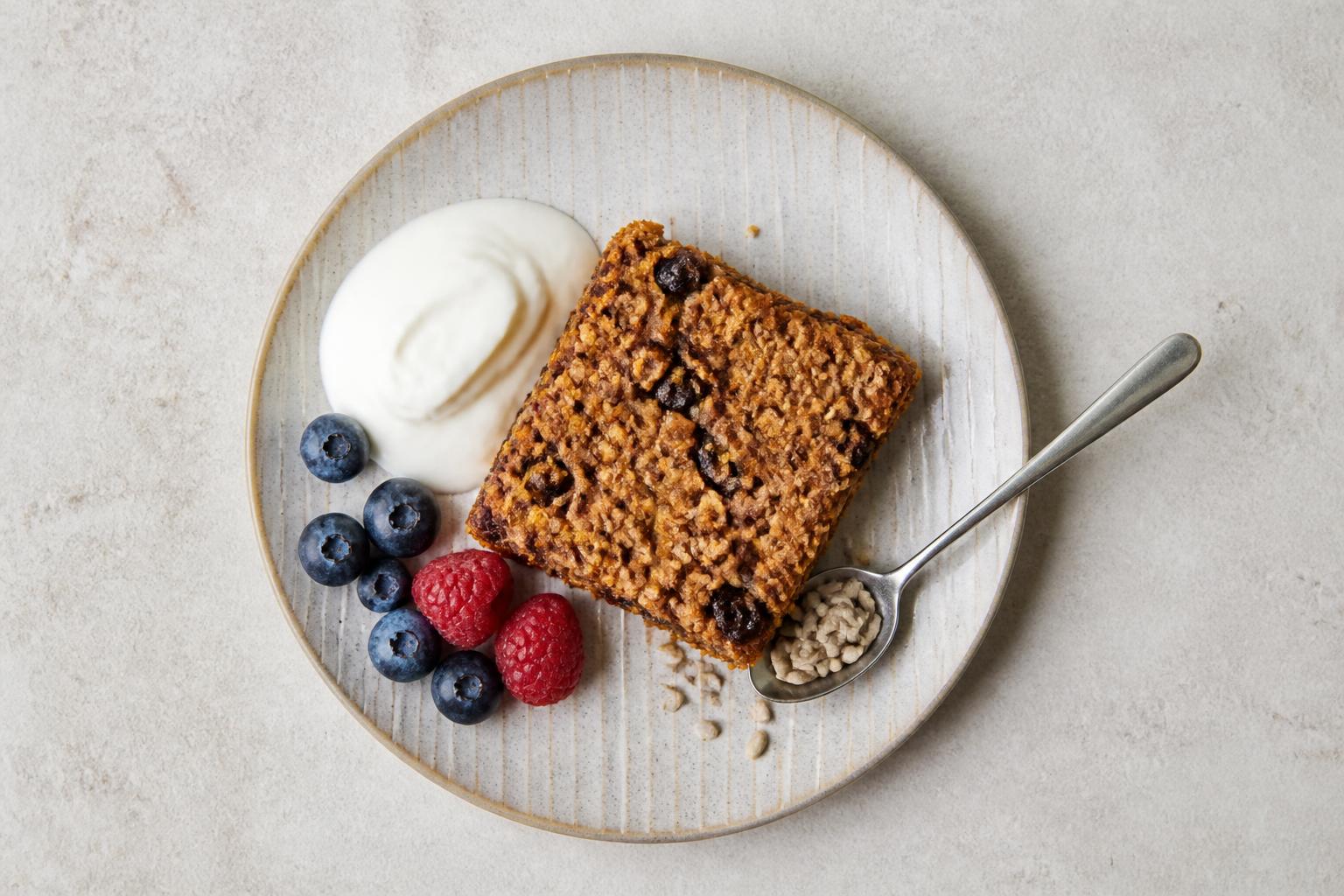
This is especially useful for foods that present themselves as oat based, fruit based, or nut based. A flapjack, granola, yoghurt, soup, or ready meal can sound wholesome, but the ingredients list reveals whether oats, vegetables, milk, or nuts are the main component, or whether sweeteners and fats dominate instead. We use this approach often when looking at snack products, and it is particularly helpful if you are trying to judge a healthier breakfast flapjack.
Added sugars are not always called sugar. On UK labels you may also see glucose syrup, fructose, dextrose, invert sugar syrup, honey, agave syrup, fruit juice concentrate, maltose, molasses, or brown rice syrup. They do not all behave identically in recipes, but from a label reading point of view they all contribute to the product’s sugar load.
The same principle applies to fats. If a product contains vegetable oil, sunflower oil, rapeseed oil, coconut oil, palm oil, butter, cream, or ghee high up the list, that helps explain the fat content you will later see in the table. The type of fat matters too. A product rich in coconut oil or butter may be higher in saturates than one made with rapeseed or olive oil.
Percentages in the ingredients list are another useful clue. Under Quantitative Ingredient Declaration rules, if an ingredient is named in the product title, pictured prominently, or emphasised in words, its percentage often has to be shown. So if a pack says “strawberry yoghurt”, “chicken and vegetable pie”, or “with honey”, you may see “strawberries 6%”, “chicken 18%”, or “honey 2%” in the list.
That percentage helps you test whether the front of pack emphasis matches the reality. A cereal advertised with berries may contain only a small amount of dried fruit. A “cheese and onion” snack may contain more flavouring than cheese. A hummus with roasted red pepper may only include a modest amount of pepper. None of this makes the food unsuitable, but it does make comparison easier.
This is also where you can start spotting fibre opportunities. Wholegrain flour, oats, beans, lentils, seeds, vegetables and fruit appearing early in the list often point to a more filling product. If that is something you are trying to improve at breakfast or lunch, our guide on how to use food labels to add more fibre at breakfast and lunch goes through practical examples.
What the nutrition table really means
The nutrition table is where the numbers sit, but they only become useful when you know how to compare them.
Most UK prepacked foods show energy, fat, saturates, carbohydrate, sugars, protein and salt. Fibre is not always mandatory on every presentation of the table, but it is commonly included and very worth checking. Values are usually given per 100g or per 100ml, and often also per portion.
Energy is shown in both kilojoules, kJ, and kilocalories, kcal. In everyday use, people usually refer to kcal as calories. This tells you how energy dense a food is, but not whether it is nutritious. Nuts, yoghurt, porridge oats and olive oil can all be relatively high in calories while still being useful foods. The number matters most when you compare similar products or portion sizes.
Fat tells you the total fat content. Saturates tells you how much of that fat is saturated fat. This is the figure front of pack labels often highlight because it is useful for comparing foods like pizzas, pastries, biscuits, cheese, desserts and ready meals.
Carbohydrate is the total carbohydrate, and sugars is the amount of sugars within that total. On UK and EU style labels, “sugars” includes naturally occurring sugars as well as added sugars. So plain milk and fruit will contain sugars even when none has been added. This is why the ingredients list matters alongside the table. A fruit yoghurt may have a similar sugars figure to another yoghurt, but one may contain mostly milk and fruit sugars while the other also includes added sugar or syrup.
Fibre matters because it affects fullness, digestion and the overall quality of many carbohydrate based foods. Higher fibre breads, cereals, crackers and snack bars often keep you going better than lower fibre alternatives. Protein can also help with fullness, but “high protein” is not automatically a sign that the whole product is a better choice.
Salt is shown as salt, not sodium, on UK consumer labels. That makes comparison easier. A food can be savoury without being especially salty, but sauces, soups, ready meals, processed meats and snacks can add up quickly across the day.
The most important comparison rule is this, use per 100g or per 100ml to compare products fairly. Portion figures are useful, but only if the portions are realistic and consistent. One cereal brand may define a portion as 30g, another as 45g. One lasagne may treat half the tray as a serving, another the whole tray. Per portion numbers can therefore make one product look lighter simply because the stated serving is smaller.
That is why we always suggest checking both. Use per 100g for like for like comparison, then check the portion you are likely to eat in real life. If you want a fuller walkthrough of that method, see our guide on comparing labels properly using per 100g or per portion.
How traffic light labels help with quick comparisons
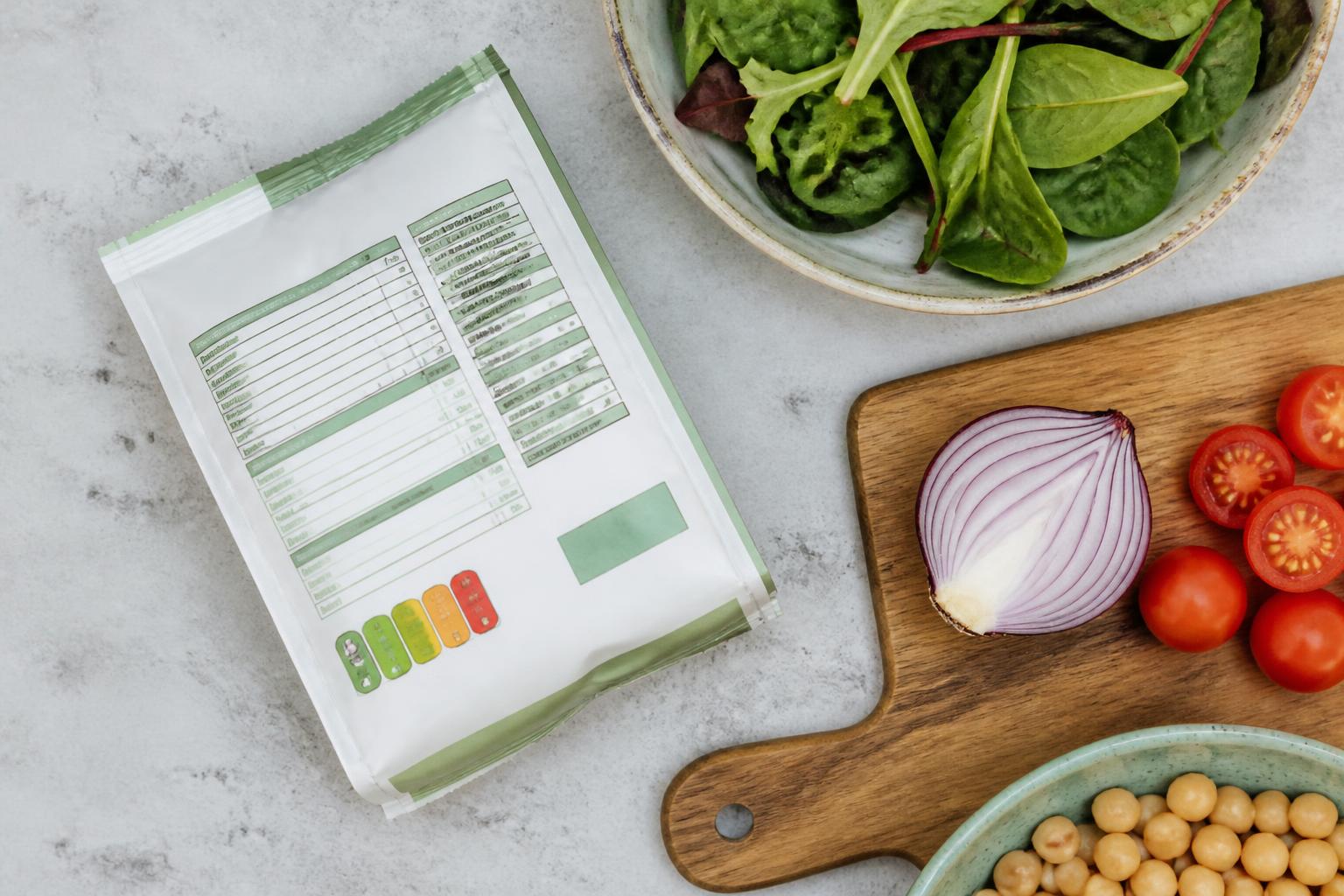
Traffic light labels are useful when you are making quick decisions between similar products. In the UK, many manufacturers and retailers use front of pack colours for fat, saturates, sugars and salt, with red meaning high, amber medium, and green low. These are often shown alongside energy per portion and the percentage of the adult reference intake.
The main advantage is speed. If you are choosing between two soups, two wraps, two chilled desserts or two breakfast cereals, the colour coding can help you spot the higher salt, higher sugar or higher saturates option in seconds.
They are most useful when all of the following are true. The products are in the same category, the pack sizes are similar, and the portion assumptions are sensible. Comparing two tomato soups or two plain yoghurts this way is straightforward. Comparing a nut mix with a cereal bar or cheddar with hummus is much less meaningful, because the foods serve different purposes and have different natural nutrient profiles.
Traffic light labels also cover only selected nutrients. They do not tell you about fibre, the degree of processing, the proportion of whole ingredients, or whether the food is likely to keep you full. A breakfast cereal can avoid red lights and still be low in fibre and not especially satisfying. A handful of nuts may show amber or red for fat, but that alone does not make it a poor choice.
Portion size is the main place where people get misled. Front of pack labels often present colours per 100g and figures per portion, or they show a portion that is smaller than what many people actually eat. If a cereal is labelled green or amber for sugar per suggested serving, but the serving is 30g and your bowl is 50g, your real intake is different.
So use the colours as a shortcut, not a verdict. They are excellent for narrowing options, especially in categories where products look similar from the front. But if something surprises you, turn the pack over and check the ingredients list and the per 100g table.
Allergens, dates and storage details that matter
For anyone managing allergies, allergen information is one of the most important parts of the label. In the UK, certain allergens must be emphasised in the ingredients list, usually in bold. This commonly includes cereals containing gluten, milk, eggs, peanuts, nuts, soya, sesame, fish, crustaceans, molluscs, mustard, celery, lupin and sulphur dioxide or sulphites above the threshold that triggers declaration.
The key point is that the emphasis helps you spot allergens quickly, but you still need to read the full list every time. Recipes do change. A product you buy regularly can switch factory, supplier or formulation.
You may also see precautionary wording such as “may contain nuts” or “not suitable for milk allergy sufferers”. This is different from an ingredient declaration. It is used where there is a risk of unintended cross contamination. For people with allergies, that distinction matters.
Dates matter too, especially the difference between “use by” and “best before”.
“Use by” is about safety. You will usually see it on foods that spoil quickly, such as fresh meat, fish, some chilled ready meals and prepared salads. Food should not be eaten after the use by date, even if it looks or smells fine. If the pack says “keep refrigerated” or gives a temperature such as 0C to 5C, that instruction is part of the safety picture.
“Best before” is about quality. It appears on foods such as cereals, tinned goods, biscuits, pasta and some snacks. The food may still be safe after that date if it has been stored properly, but the texture or flavour may not be at its best.
Storage instructions are not filler. “Refrigerate after opening and consume within 3 days” is there because once the pack is opened, the safety and shelf life change. The same applies to “cook from frozen”, “do not refreeze once defrosted”, or “once opened, keep upright in the fridge”. These instructions affect both safety and quality.
This becomes especially relevant with cooked foods and leftovers. Labels on pulses, grains and ready to eat items often give refrigeration guidance that is more useful than people realise. The same logic applies when handling home cooked ingredients, which is why we have covered practical fridge safety in pieces such as how long cooked lentils keep in the fridge safely.
Nutrition and health claims without the spin
Claims on pack can be helpful, but they work best when you know what they do and do not mean.
In the UK, nutrition and health claims are regulated. A product cannot simply say “low fat” or “high protein” because it sounds good. It has to meet the legal conditions for that claim. The exact framework has diverged in some respects between Great Britain and the EU since Brexit, but the practical consumer facing meaning of common claims remains broadly familiar.
“Low fat” means the product meets a set threshold for fat. That can be useful when comparing yoghurts, dressings or ready meals, but it does not tell you about sugar, fibre, salt, or portion size. A low fat dessert can still be very sweet.
“No added sugar” means no sugars have been added, and no other ingredient has been used for its sweetening properties in place of sugar. But the food may still contain a fair amount of naturally occurring sugar, especially if it includes fruit juice concentrate or dried fruit. Check the sugars line in the table and the ingredients list to see the whole picture.
“High protein” can be relevant if you want a more filling yoghurt, snack or lunch option, but again it does not cancel out the rest of the label. A high protein bar may also be high in sweeteners, saturated fat, or calories for its size.
Other common claims include “source of fibre”, “reduced sugar”, “light”, “wholegrain”, and “contains no artificial preservatives”. Some are tightly defined, some are looser in everyday interpretation, and some sound more meaningful than they are. “Reduced sugar” only means reduced compared with a reference product. It does not mean low sugar in absolute terms. “Wholegrain” sounds positive, but the label may still show refined flour ahead of wholegrain ingredients.
The practical check is simple. When you see a claim, ask three questions.
What exactly is being claimed? Compared with what? Does the rest of the label support it?
If a cereal says “high in fibre”, check whether whole grains appear early in the ingredients list and whether the fibre figure is genuinely useful compared with alternatives. If a drink says “no added sugar”, check whether it is still energy dense or easy to overconsume. If a yoghurt says “high protein”, check the sugar and portion size too.
That is the habit that makes food labels genuinely useful. Start with the ingredients. Use the nutrition table to compare per 100g, then sense check the portion. Use traffic lights for speed, but not as the final word. Read allergens, dates and storage instructions carefully. Treat claims as one piece of information, not the conclusion.
Do that consistently, and everyday choices become clearer without turning shopping into homework.

Questions about this article or a correction to suggest? Get in touch. Read more about our editorial approach.