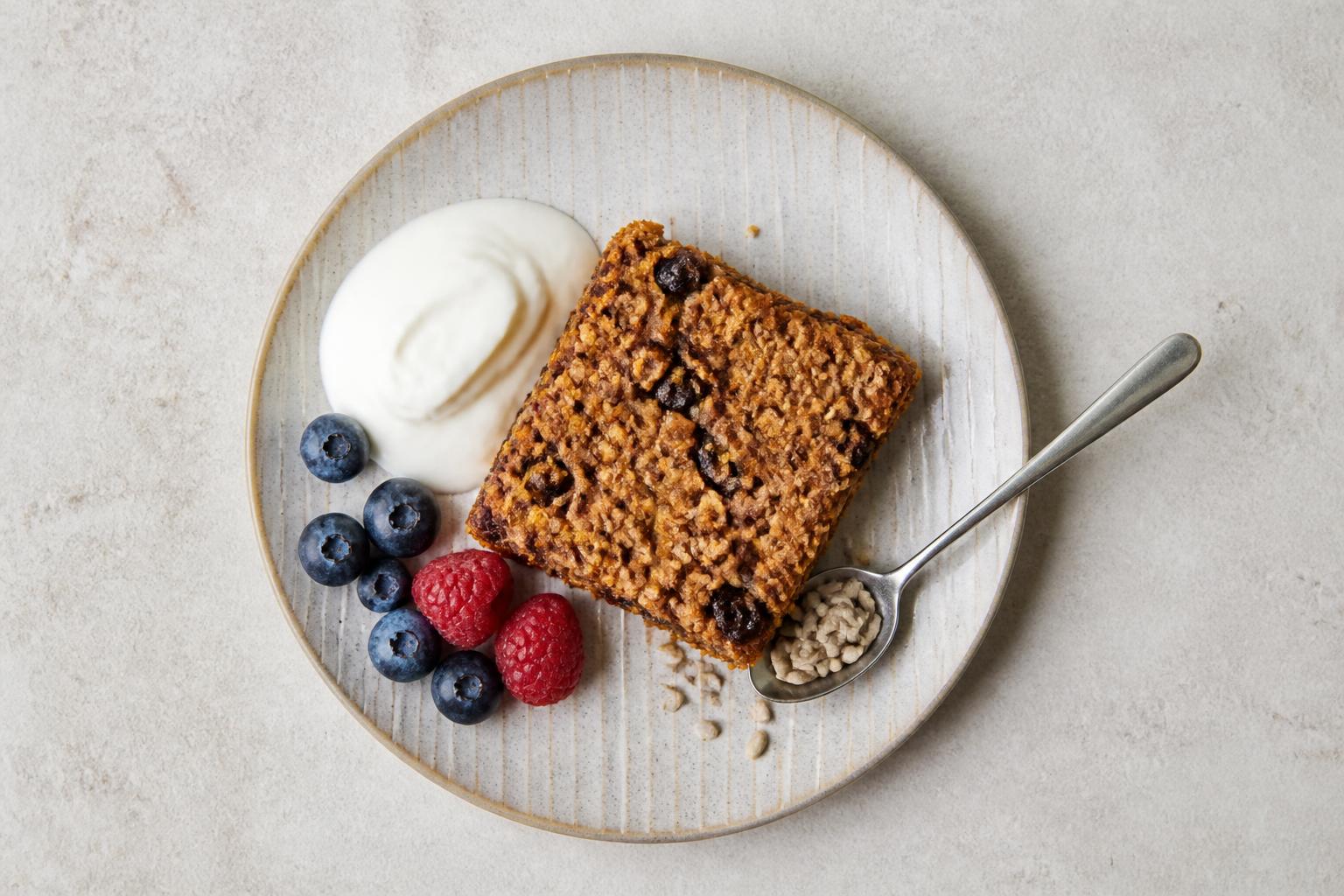
A breakfast flapjack can be a reasonable choice, but not every flapjack marketed for mornings is as balanced as it looks. Oats, seeds and dried fruit give a strong healthy impression, yet many products are still quite high in sugar, energy and fat for the amount of fullness they provide. The quickest way to judge one is to check three things together: the ingredients list, the nutrition table, and the actual weight of one bar.
In practice, a healthier breakfast flapjack is usually one where oats are the main ingredient, sugar does not appear in several forms near the top of the list, fibre is meaningful rather than token, and the portion is substantial enough to count as breakfast without quietly delivering the energy of a pastry. If you want a breakfast flapjack to work on an ordinary weekday, it needs to do more than sound wholesome on the front of the pack.
What makes a breakfast flapjack seem healthy
Breakfast flapjacks often look healthier than many other grab and go options for understandable reasons. Oats are familiar, filling and associated with a decent breakfast. Seeds suggest fibre and healthy fats. Fruit implies natural sweetness rather than confectionery. Packaging often leans into that picture with words such as baked, wholesome, source of fibre, or made with wholegrain oats.
Some of that impression is fair. Oats can contribute fibre, especially beta glucan, and they usually make more nutritional sense than highly refined cereal ingredients. Seeds can add texture, unsaturated fat and some micronutrients. Fruit can bring flavour and make a product less dependent on artificial flavourings.
The problem is that the overall effect of a flapjack depends on the full recipe, not on the ingredients that sound best when listed on the front. A flapjack made with oats can still contain a large amount of syrup, sugar or fruit purée concentrate. Seeds may be present in small quantities, enough to appear in the product name but not enough to change the nutrition profile much. Dried fruit can increase sweetness rapidly because the water has been removed, which means a small handful contributes more sugar than many people expect.
There is also a format issue. A flapjack is dense. That is part of its appeal. It travels well, does not need refrigeration, and is easy to eat on a train or at a desk. But density means energy adds up quickly. A small bar can contain a lot of oats, fat and sweetener in a compact portion. That does not make it bad, but it does mean the healthy image can run ahead of the reality.
This is why the question is not simply whether breakfast flapjacks are healthy. It is which flapjack, in what portion, and compared with what alternative. If a bar is mostly oats with modest sweetness and enough fibre to keep you going, it may be a practical breakfast. If it is essentially a sweet traybake sold in breakfast packaging, it may fit better as an occasional snack.
What the label can tell you in two minutes
You can learn a lot from a flapjack label very quickly if you read it in the right order.
Start with the ingredients list. In the UK, ingredients are listed by weight, highest first. If oats come first, that is usually a good sign. If the first few ingredients are oats, glucose syrup, sugar, golden syrup and fruit juice concentrate, you are looking at a sweeter product than the front of the pack may suggest. Watch for several different sweeteners used together. A brand may split sweetness across sugar, syrup, honey, date paste or concentrated fruit ingredients, but your body still receives them as sugars.
Next, look at whether the promising ingredients are central or decorative. If the product is called something like apple, chia and pumpkin seed flapjack, check whether those ingredients appear in meaningful amounts or near the end of the list. The name can make them sound structurally important when they are really there for flavour and marketing.
Then move to the nutrition table. For a quick breakfast judgement, look at values per bar first, not just per 100g. Per 100g is useful for comparing products, but most people eat the bar, not 100g exactly. A flapjack may seem moderate on a per 100g basis, then turn out to be large enough that one serving gives far more sugar or energy than expected.
After that, use the per 100g column to compare one product with another. This helps when bars differ in size. If one flapjack is 50g and another is 80g, a per bar comparison alone can be misleading.
Portion size matters more than the front of pack wording. If the label defines one serving as half a flapjack, ask yourself whether anyone would actually stop there on a rushed morning. If not, judge the whole pack or whole bar. This sounds obvious, but it is where many supposedly healthier breakfast bars get a free pass.
Also check whether the nutrition panel gives fibre. In the UK and EU, fibre is usually listed separately, and that figure is worth using. Not all front of pack claims tell you much. “Source of fibre” can still describe a product that is relatively sugary or energy dense. The detailed panel gives a clearer picture.
Finally, keep an eye on traffic light colours if they are provided, but do not rely on them alone. Front of pack traffic lights are widely used in the UK, but they are voluntary, not mandatory. They can help with a quick scan, especially for sugars and saturated fat, yet they do not tell you whether a portion will keep you full. For that, you still need the ingredients, fibre figure and serving size.
If you want a broader method for reading breakfast packaging, our guide on using food labels to add more fibre at breakfast and lunch sets out the same label reading habits across other foods as well.
Sugar, fibre and fat in real-world flapjacks
These three parts of the panel do most of the work when you are deciding whether a flapjack suits everyday breakfasts.
Sugar comes first because it is often the biggest gap between healthy branding and nutritional reality. In a flapjack, sugar does not only come from obvious ingredients like sugar or syrup. It can also come from honey, date paste, fruit purée, fruit juice concentrate and dried fruit. None of these automatically makes a flapjack unhealthy, but they all count when you are looking at total sugars on the label.
For breakfast, the practical question is not whether the sugar is natural or added in a way that sounds artisanal. It is whether the bar is sweet enough, and low enough in fibre or protein, that you are hungry again soon. A flapjack that behaves like a sweet snack at 9am may not be much use if you are trying to get through to lunch without grazing.
Fibre helps here. Oats can contribute, but not all oat based bars are high in fibre. Once syrups, fats and sweet extras are added, the fibre density can be less impressive than people assume. A flapjack with a useful amount of fibre is generally more likely to feel like breakfast rather than cake in a wrapper. Fibre also gives you a better reason to choose it over sweeter cereal bars that happen to sit in the same shelf section.
Fat is where context matters. Traditional flapjacks often contain butter or oil, and many also include seeds or nut butters. Fat is not a problem by itself. In fact, some fat can help a breakfast feel more satisfying. The issue is the combination of fat, sugar and density. A flapjack can become very energy rich without becoming very filling, especially if the portion is small and easy to eat quickly.
Saturated fat is worth checking, especially if butter, palm fat or coconut is used. UK labels show total fat and saturates separately. A product can contain a fair amount of total fat from seeds and still be lower in saturates than a butter heavy alternative. That difference is useful when comparing products in the same category.
Do not forget texture and speed of eating. A bowl of porridge takes time to eat. A flapjack can disappear in minutes, even when the energy content is similar. That changes how full many people feel afterwards. So when people ask whether breakfast flapjacks are healthy, the honest answer often depends less on a single nutrient and more on how sugar, fibre and fat interact in the portion you actually eat.
When a breakfast flapjack is a practical option
A breakfast flapjack makes the most sense when convenience genuinely matters. If you leave early, commute, travel for work, or need a shelf stable option to keep in a bag or drawer, a decent flapjack can be useful. It is often more practical than yoghurt, less messy than porridge, and more substantial than a standard cereal bar.
It can also work on mornings when breakfast is split in two. Some people are not ready for a full meal at 6.30am but want something at 8.30am. In that situation, a flapjack can bridge the gap, especially if you pair it with something that adds protein or volume, such as milk, a plain yoghurt, or a piece of fruit.
Where flapjacks are less impressive is in satiety relative to expectations. Because oats have a strong healthy reputation, people sometimes expect any oat bar to keep them full for hours. Some do not. A compact flapjack that is high in sugars and modest in fibre may feel substantial while you are eating it, then wear off quickly. That is particularly common with smaller bars that are sold as breakfast but are only slightly larger than snack bars.
They can also be less suitable if you tend to eat on autopilot. Dense bars are easy to underestimate. If you routinely eat one on top of another breakfast, or add it as a side to a coffee shop pastry because it looks healthy, it stops being a practical swap and starts becoming an extra.
For some households, flapjacks are also useful as backup food. Keeping a few in the cupboard can prevent the all or nothing pattern where a missed breakfast turns into buying whatever is available at 10am. We see the same principle across other healthy breakfast foods that keep mornings practical. Foods do not need to be perfect to be useful. They need to fit real mornings better than the alternatives you would otherwise choose.
If you are buying for children, the same caution applies, perhaps more so. Bars marketed as breakfast can still be quite sweet, and smaller children may not find them as filling as adults assume. Our piece on healthy school-morning breakfasts kids will actually eat covers ways to think about convenience without relying too heavily on packaged bars.
How to compare breakfast flapjacks with other quick breakfasts
The fairest comparison is not flapjack versus an ideal breakfast prepared in a calm kitchen. It is flapjack versus what you would realistically eat instead.
Compared with toast, a flapjack is usually denser and sweeter, but it may also be more portable and sometimes higher in fibre, depending on the bread. Two slices of wholemeal toast with peanut butter may offer a different balance of fibre, fat and fullness than one flapjack, and for many people it will feel more like a meal. But toast is less convenient once you are out of the house.
Compared with porridge, flapjacks generally lose on volume and often on satiety. Porridge contains water or milk, so it gives bulk as well as oats. That usually helps with fullness. Flapjacks win on portability and shelf life. If you have time to make porridge, it is often the more balanced oat based breakfast. If you do not, a well chosen flapjack may be the realistic second best.
Compared with yoghurt, the answer depends heavily on what kind of yoghurt and what else goes with it. A plain yoghurt with fruit can be less sugary than a sweet flapjack and may provide more protein. A heavily sweetened yoghurt with granola clusters can easily end up in the same territory as a flapjack, just in a different format. Yoghurt also needs refrigeration, which matters in real life.
Compared with cereal, flapjacks are easier to portion in one sense and harder in another. One wrapped bar is obvious. A bowl of cereal can quietly become much larger than intended. On the other hand, many breakfast cereals can be adjusted with milk, fruit or yoghurt to create a more filling meal, while a flapjack is fixed. You get what is in the wrapper.
The most useful comparison point is usually this: does the flapjack give you enough breakfast for the convenience it offers? If yes, it may deserve a place in your routine. If not, it may be better treated as a snack, even if the packaging says breakfast.
A sensible way to compare is to ask four simple questions across any quick breakfast:
- What is the actual portion I will eat?
- How much sugar does that portion contain?
- Is there enough fibre, and ideally some protein or fat, to make it satisfying?
- Will I still want something else within an hour?
That approach keeps the decision grounded. It also stops you being distracted by category labels. Breakfast foods are not automatically balanced, and snack foods are not automatically poor choices. The label and the portion tell you more than the shelf sign.
So, are breakfast flapjacks healthy? Some are healthier than others, and some are practical enough to earn their place. The better ones rely on oats as the main ingredient, keep sweetness under control, provide worthwhile fibre, and come in a portion that makes sense for a morning meal. The weaker ones borrow the language of health while behaving much more like a sweet treat. If you can read the label in two minutes, you can usually tell which is which.

Questions about this article or a correction to suggest? Get in touch. Read more about our editorial approach.