
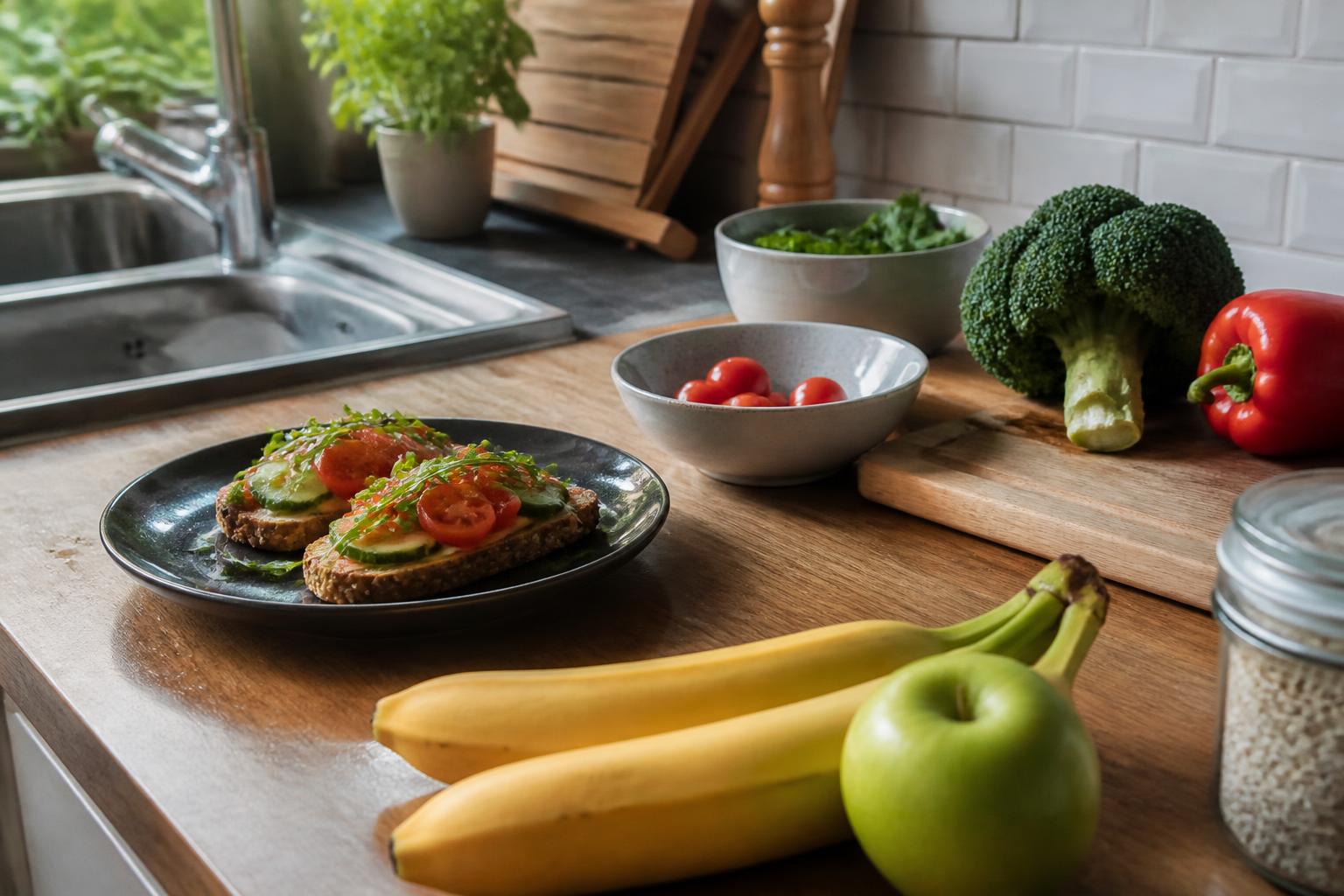
Helping a teenager eat well rarely comes from tighter control. It usually works better when we make food predictable, available and ordinary, while accepting that appetite, preferences and routines can swing sharply through the teenage years. Healthy eating for teenagers is less about producing a perfect menu and more about building patterns that still work on rushed school mornings, late training nights, social weekends and growth spurts.
For most families, the most useful aim is simple. Offer regular meals, keep a few filling snacks within reach, include a mix of carbohydrates, protein, fruit, vegetables and dairy or alternatives across the day, and avoid turning every biscuit or skipped breakfast into a standoff. Teenagers need guidance, but they also need room to listen to hunger, fullness and taste as they grow into managing food for themselves.
What changes in the teenage years make eating feel harder
Teenagers are not just older children following adult advice badly. Their eating can feel harder because their bodies and daily lives are changing at the same time.
Puberty brings growth, shifts in body composition and changing energy needs. Some teenagers seem hungry all the time for a while, then less interested in meals the next week. That does not automatically mean something is wrong. Appetite can move around with growth, sleep, hormones, stress and activity.
Routines also become less stable. A younger child may eat at the same table at roughly the same times each day. A teenager may leave the house early, buy food near school, eat lunch quickly between lessons, train after school, come home late and snack while revising. Advice that sounds sensible for adults, such as cooking everything from scratch or never eating on the go, can miss the reality of school days.
Social eating matters more too. Teenagers eat with friends, compare lunch choices, visit cafés, order takeaways and notice what other people say about bodies and dieting. Food can become tied up with fitting in, independence and identity. That is one reason moral language, such as “good”, “bad”, “clean” or “junk”, often causes more trouble than it solves.
Sleep patterns can add another layer. Many teenagers are not hungry early in the morning, especially if they are short on sleep and rushing out. That does not mean breakfast is irrelevant, but it does mean a realistic breakfast may be toast and peanut butter, a banana and yoghurt, or a drinkable option taken along, rather than a cooked meal at 7 am.
This is also the stage where adult messages about weight and health can land badly. A teenager may hear “eat healthier” as “eat less” or “your body is a problem”. We find it more useful to frame food around energy, concentration, mood, sport, growth and feeling physically comfortable. Our piece on what healthy eating really helps with day to day is useful background if you want to keep the focus practical rather than moral.
What a balanced day can look like for a teenager
In the UK, the broad shape still comes back to familiar healthy eating guidance. Across the day, we are looking for starchy carbohydrates, fruit and vegetables, beans, pulses, fish, eggs, meat or other proteins, and dairy or fortified alternatives. The Eatwell Guide is the usual reference point in the UK. Food labelling rules may overlap with wider European practice in some areas, but public healthy eating guidance is set nationally, so UK advice is the one to use here.
That does not mean every meal has to be nutritionally perfect. Over a week matters more than over one day.
Breakfast can be small and still count. Examples include porridge with milk and fruit, wholegrain toast with eggs, cereal with yoghurt, a bagel with peanut butter, or overnight oats if mornings are chaotic. If a teenager genuinely cannot face much food early, a later school snack may need to do some of the work.
Lunch needs to be filling enough to get through the afternoon. In practice that often means a carbohydrate base, some protein, something for crunch or freshness, and one or two easy extras. A packed lunch might be a chicken wrap, pasta salad with cheese and sweetcorn, hummus sandwiches, or leftovers from the previous evening, plus fruit, yoghurt and a flapjack or crackers. School lunches can work just as well when there is enough substance in them.
Evening meals do not need a separate “teen menu”. A balanced family meal might be chilli with rice, fish fingers with potatoes and peas, lentil pasta bake with salad, chicken curry with naan and cucumber, or beans on toast with grated cheese and tomatoes when time is short. We often overcomplicate healthy eating when ordinary combinations already cover a lot.
Snacks matter more in this age group than many adults expect. For teenagers, snacks are not always a sign of poor habits. They can be a practical bridge between school, sport and homework. Useful options include toast, fruit with yoghurt, oatcakes and cheese, a smoothie, nuts if appropriate, crumpets, cereal and milk, or a sandwich. If a teenager is constantly hungry after school, it usually helps to plan a proper snack rather than trying to ban grazing and then dealing with a meltdown at 5 pm.
It also helps to avoid making one food carry too much meaning. Crisps in a lunchbox or pudding after dinner do not cancel out an otherwise balanced day. If you want a simple way to think about weekly patterns rather than perfection, our guide to a simple healthy eating planner for busy UK weeks gives a practical framework.
How to handle school, sport and after-school hunger
The hardest part of healthy eating for many families is not knowing what counts as balanced. It is getting food into a teenager at the times when they will actually eat it.
If breakfast is regularly missed, first ask why. Is there no time? Are they not hungry until later? Is the house simply too frantic? The fix depends on the reason. A teenager who will not sit down for breakfast may still take a banana, breakfast bar, yoghurt pouch or toast to eat on the way. If they are hungry mid-morning, it may be worth packing a more substantial snack if school rules allow it.
Packed lunches often fail because they are too small, too repetitive or awkward to eat quickly. Teenagers usually do better with food that survives being carried around and can be eaten without fuss. Wraps, pasta pots, rice salads, filled bagels, savoury muffins, hard-boiled eggs, fruit, popcorn, yoghurt and flapjacks are all practical. Leftovers are often underused. Cold pizza, frittata, roast chicken in a roll or leftover noodles can be perfectly sensible lunch food.
For after-school sport, timing matters. If training starts soon after lessons end, a large lunch alone may not be enough. A pre-training snack with carbohydrate and a little protein can help, such as a banana and yoghurt, toast with jam, a cereal bar and milk, or a sandwich half. The aim is something easy to digest and easy to carry.
After training, many teenagers come home ravenous. This is where households often end up in conflict, because adults want to “save appetite” for dinner while the teenager is already beyond hungry. A planned bridge snack can help, especially if the evening meal is still an hour away. Milk, toast, fruit, soup, a sandwich or leftovers can take the edge off without turning into an endless pick-and-mix of cupboard foods.
Hydration matters too, especially for active teenagers. Water should be the default. Milk can also contribute usefully. Energy drinks are a separate issue and are not the same as sports drinks. Most teenagers do not need them for ordinary school or club sport.
If school, activities and social plans make the week feel disjointed, it can help to step back and look at patterns rather than isolated meals. Our article on how UK healthy eating campaigns shape everyday food choices explains why so much family food advice sounds simple in theory but gets messy in real life.
Why food battles usually backfire
Food battles usually start with good intentions. Adults worry a teenager is living on beige food, skipping meals or eating too many snacks, so they tighten rules. The problem is that pressure often makes eating more difficult, not less.
When teenagers feel watched, judged or controlled, they may dig in. Some start eating less at family meals and more privately. Some become defensive about ordinary preferences. Some swing between restriction and overeating because food now feels emotionally loaded. Even well-meant comments about “being healthy” can be heard as criticism.
Restriction can also make certain foods more powerful. If biscuits, chocolate or takeaway are treated as forbidden, they tend to become more charged and more desirable. That does not mean having no boundaries at all. It means using boundaries that are calm and workable. Families generally do better with regular meal structure, predictable snack options and neutral language than with bans, bargaining or lectures.
We find a few approaches consistently more helpful.
First, keep offering a range of foods without forcing a verdict on each one. A teenager does not need to love every vegetable to learn to eat reasonably well.
Second, let some preferences stand where the nutritional cost is low. If they hate tomatoes but will eat peppers, cucumber and carrots, that is not a crisis.
Third, put effort into what is available, not into commentary. A fruit bowl on the counter, wraps in the fridge, leftovers portioned for lunch and bread that can become toast in two minutes usually achieve more than repeated reminders.
Fourth, avoid assigning moral value to appetite. “You’re always eating” and “do you really need that?” can do real damage, particularly during growth phases or in teenagers already feeling self-conscious.
Shared meals still matter, but not because every dinner must become a nutrition lesson. Sitting down together when possible helps teenagers see balanced eating as normal adult life, not as a correction aimed at them.
When picky habits, dieting talk or low appetite need closer attention
Not every awkward phase needs intervention. It is common for teenagers to go through periods of repetitive eating, strong dislikes, sudden enthusiasm for protein foods, skipping breakfast or changing appetite during exams or growth spurts. On its own, that may just be part of adolescence.
What deserves closer attention is the pattern around the food.
Picky habits may need more support if the range of accepted foods is becoming narrower, whole food groups are being cut out without a clear reason, school lunch is rarely eaten, or mealtimes are causing high distress. Low appetite may need a second look if it lasts, affects growth, energy, concentration or mood, or comes with stomach pain, nausea or persistent tiredness.
Dieting talk is worth taking seriously, especially if a teenager starts labelling foods as “bad”, skipping meals to compensate, showing fear about normal portions, or becoming highly preoccupied with calories, weight or “earning” food through exercise. The same applies if exercise becomes compulsive rather than enjoyable.
Some warning signs justify prompt support rather than watchful waiting. These include noticeable weight change, repeated dizziness, fainting, food rituals, hiding food, frequent binge eating, vomiting, avoiding eating with others, or intense distress about body shape. Parents and carers do not need to be certain that there is a serious problem before seeking advice. Uncertainty is common, and it is reasonable to ask for help early.
General articles, including this one, have limits. We can describe patterns that are often useful, but we cannot assess an individual teenager’s growth, medical history or relationship with food. If you are worried, a GP, school nurse, health visitor for younger siblings in the family context, or a registered dietitian can help you work out whether this looks like a normal phase or something that needs proper assessment. If the concern centres on very limited eating, our guide to healthy eating that works for fussy eaters may also help you think through practical next steps.
The main point is that healthy eating for teenagers works best when it is steady rather than intense. We are not trying to produce a flawless eater by the end of Year 9. We are trying to help a young person build enough food confidence, routine and flexibility to feed themselves well over time. That usually means less pressure, more structure, and a household tone that treats food as part of ordinary life rather than a daily test.

Questions about this article or a correction to suggest? Get in touch. Read more about our editorial approach.