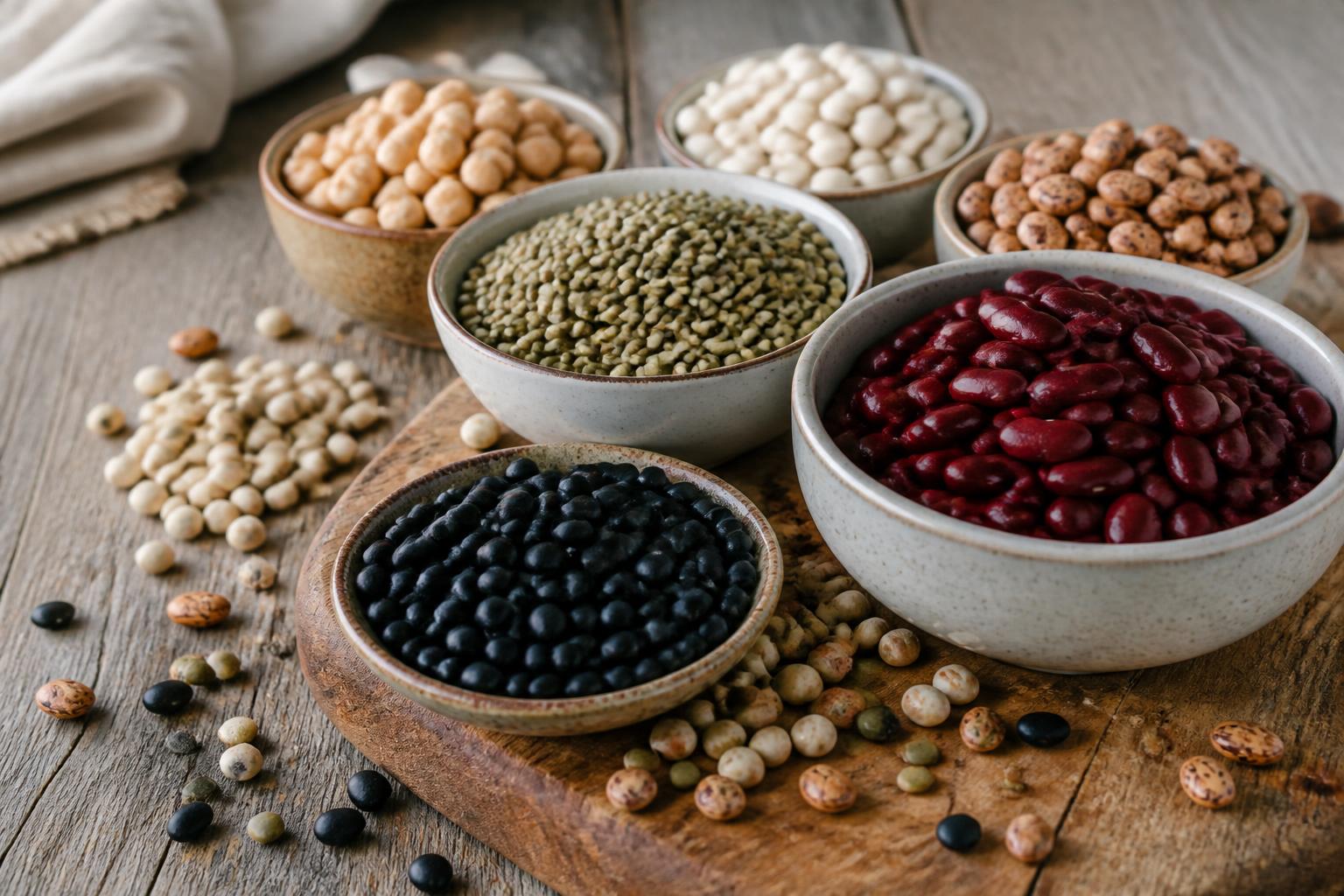
If you want the short answer first, the beans that usually come out near the top for protein are soy beans, black beans, kidney beans, haricot beans and cannellini beans, with broad beans and edamame also worth noting depending on how they are counted. For most standard supermarket beans eaten cooked, drained and ready to use, the differences are real but not dramatic. Many common beans sit in a fairly narrow range once they are on the plate.
That is why the better question is not only which beans have the most protein, but how the numbers are being measured and what a normal serving actually gives you. A bean that looks far ahead on a dried-weight table may be much less different once cooked, while a lower-salt tinned option that you will actually use twice a week may be more helpful in practice than a slightly higher-protein bean you rarely buy.
Which beans are highest in protein?
If we line up beans as people in the UK usually buy and eat them, protein rankings tend to follow a fairly familiar pattern.
Soy beans are normally the clear outlier. They are much higher in protein than most other beans, whether you buy them dried, frozen as edamame, or in another minimally processed form. If someone asks which beans are highest in protein in a straightforward nutritional sense, soy beans are usually the first answer.
After that, the field becomes tighter. Black beans, kidney beans, pinto beans, navy beans, haricot beans and cannellini beans often cluster reasonably close together per 100g cooked. Exact order changes by data source, brand and preparation method, but these are the names you are most likely to see near the top of ordinary bean lists.
Broad beans are a useful special case. Fresh broad beans are not usually compared directly with dried pulse beans because their water content is different, but they can still contribute a decent amount of protein in a meal. The same is true of edamame, which are immature soy beans. They are not usually what people mean by a tin of beans, but nutritionally they are relevant.
Baked beans deserve a separate mention. The beans themselves, usually haricot beans, are not low in protein. But baked beans are sold in sauce, so the protein per 100g of the finished product is diluted by the added liquid. They can still be a practical source of protein, especially on toast or with eggs, but they will not look as concentrated on a label as drained plain beans.
Lentils, chickpeas and peas also enter this conversation in everyday life, even though they are not all “beans” in the narrow sense. Chickpeas are often compared with beans because they are used in similar meals, and their protein content is in the same general territory. Lentils can be a little more protein-dense in some cooked forms and are often quicker to prepare. If your real aim is simply to increase protein from pulses, it is worth looking beyond the bean aisle alone.
So the broad order most readers will see is this: soy beans first by a clear margin, then a group of common cooked beans with only modest differences between them, then products such as baked beans where sauce or extra water lowers the figure per 100g.
Why protein numbers for beans can look so different
This is where most confusion starts. Protein values for beans can vary a lot on paper because the product being measured is not always the same.
Dried beans are the most obvious example. Before cooking, they contain very little water, so every nutrient looks concentrated. Once you soak and boil them, they absorb water and become much heavier. The total protein in the original beans has not vanished, but it is now spread through a larger cooked weight. That is why 100g dried beans and 100g cooked beans are not remotely equivalent.
The same issue affects tinned beans. A tin contains beans plus liquid. If a label gives values “as sold”, the water in the tin changes the figure. If the values are given for drained beans, the protein per 100g will be higher because some of that extra liquid has been removed. In UK supermarkets, nutrition panels usually tell you clearly whether the values are for the product as sold or prepared, and whether a drained weight is stated. It is worth checking rather than assuming.
Drained and rinsed beans can differ again. Rinsing does not usually change protein much, but it can alter sodium levels if the beans were packed in salted liquid. That matters if you are comparing canned products for overall usefulness, not just protein.
Cooking method also shifts the numbers slightly. Beans simmered until very soft may hold a bit more water than firmer beans. Home-cooked beans may therefore compare differently with canned ones, even when they are the same type. One brand’s cannellini beans can also be a little wetter than another brand’s, which is enough to move a per-100g figure.
This is why rankings jump around online. One table may compare dried beans, another cooked beans, another canned and drained beans, and another mixed products including beans in sauce. None of those tables is necessarily wrong, but they are answering different questions.
For ordinary shopping and meal planning, cooked or drained values are usually the most useful. They tell you what you are actually eating. If you are standing in a UK supermarket deciding between a tin of kidney beans and a tin of black beans, the label that matters is the one for the food in the form you will serve.
How much protein do common beans provide in a normal portion?
Per-100g numbers are useful for comparison, but most people do not eat exactly 100g of beans on their own. Normal portions give a clearer picture.
A common UK serving is about half a standard tin of beans once drained, depending on the product. In a chilli, curry, salad or soup, that often works out as one person’s portion. For many plain beans, that sort of serving gives a meaningful but moderate amount of protein, enough to support a meal, but not usually enough to carry it alone if you have high protein needs.
A fuller bowl-based meal might use a whole tin split between two generous portions, or one portion could include 150g to 200g cooked beans if beans are the main ingredient. At that point, the protein contribution becomes more substantial. You also get a lot of fibre, which is one reason beans are filling even when the protein number is not as high as some people expect.
Baked beans are a good example of why portion context matters. Per 100g, they do not look especially high in protein because of the sauce. But a decent serving on toast still contributes some protein, and if you add cheese, eggs or wholegrain bread the meal becomes much more robust nutritionally.
For practical meal building, it helps to think in combinations:
- Half a tin of kidney beans in a chilli with rice gives moderate protein from the beans, plus extra from the rice.
- A bean salad with cannellini beans, tuna and vegetables pushes protein much higher than beans alone.
- Edamame as a side or snack often gives a stronger protein return for the portion than many other beans.
- A soup based on haricot or black beans can be satisfying, but if it is your main meal you may want another protein source alongside it.
This matters for readers trying to support exercise, appetite control or more balanced weekday meals. Beans are useful, but they are not all-purpose high-protein foods in the same way that chicken, fish, Greek yoghurt or tofu can be. They sit somewhere between carbohydrate and protein foods, with fibre as a major strength.
If you are looking at food labels regularly, our guide to healthy food swaps that fit everyday UK eating covers the same practical approach, looking at what you are likely to eat in real portions rather than idealised numbers.
Do higher-protein beans make a better everyday choice?
Not automatically.
A bean with slightly more protein is not always the best buy for everyday eating. Fibre, salt, convenience, taste and what else is in the meal all matter.
Fibre is one of the main reasons beans are worth eating regularly. Many beans that are only modestly different in protein are all strong fibre sources. That can support fullness, digestion and overall dietary quality. If one bean has a little less protein but you enjoy it more and use it more often, it may be the better choice in practice.
Salt is another consideration, especially with canned products. In the UK, tinned beans can vary a lot in sodium depending on whether they are packed in brine, water or sauce. Rinsing helps, but if you eat canned beans often it is sensible to compare labels. A slightly lower-protein bean with less salt may suit your routine better than a saltier option. This is particularly relevant for baked beans, mixed bean salads and flavoured ready-to-eat pouches.
Convenience matters too. Tinned beans are easy, cheap and shelf-stable. Dried beans can be economical and flexible, but they need soaking and longer cooking, with a few exceptions depending on the pulse. If a convenient bean format means you add pulses to meals three times a week instead of once a fortnight, that usually outweighs small differences in protein ranking.
There is also the question of how beans fit into ordinary British eating patterns. Beans work well in soups, stews, traybakes, salads, jacket potatoes and pasta dishes. They can stretch meat, replace some meat, or simply make a meal more substantial. A bean that suits those patterns is often more useful than one that wins a narrow nutrition comparison.
For example, cannellini beans blend well into soups and tomato-based dishes. Black beans hold up nicely in chilli and grain bowls. Butter beans work in warm salads and casseroles. Edamame fit stir-fries and quick lunches. None of that is trivial. The best bean is often the one that works with the meals you genuinely cook.
That broader view is also why we often place beans within a whole-meal pattern rather than treating them as a single metric food. If you are building balanced cold-weather meals, healthy winter foods that keep everyday meals balanced looks at the same issue from the meal level rather than the ingredient level.
What beans can and cannot do for your protein intake
Beans can make a valuable contribution to protein intake, but they have limits.
One important point is protein quality. Most beans are not “complete proteins” in the sense of providing all essential amino acids in the same balance as animal foods or soy. They tend to be lower in methionine, while grains are often lower in lysine. That is where the old advice about combining beans with rice comes from.
In practice, for most healthy adults eating a varied diet across the day, you do not need to combine complementary proteins in the same mouthful or even the same meal. If your overall diet includes a mix of pulses, grains, nuts, seeds and, where relevant, animal foods, amino acid needs are usually covered without micromanaging pairings.
The exception is when diets are very restricted, total food intake is low, or protein needs are unusually high. Someone who is vegan and trying to maximise protein for muscle gain, an older adult with reduced appetite, or a person recovering from illness may need to be more deliberate. In those cases, soy foods, dairy, eggs, fish, meat, tofu, tempeh or protein-fortified foods may help more than simply choosing the highest-protein bean.
Soy is again a notable exception because soy protein is generally considered higher quality than most other bean proteins. That does not mean other beans are poor foods. It means they are best understood as part of a wider pattern.
Beans also bring carbohydrate. That is not a flaw, but it does mean they are different from lean protein foods. If you are trying to hit a high protein target within a tight calorie budget, beans alone may not be the most efficient route. If you want satisfying, affordable foods that support fibre intake and help meals go further, they are excellent.
Individual tolerance matters as well. Some people digest beans comfortably, while others need to increase them gradually, rinse canned beans well, or choose smaller portions. If bloating is an issue, the “best” bean nutritionally may not be the one you feel best eating regularly.
For readers focused on heart health, this wider picture matters more than chasing tiny differences between bean varieties. Beans can support a heart-friendly way of eating because of their fibre and because they can displace foods higher in saturated fat. Our guide to heart-healthy foods that work in everyday meals covers that broader pattern.
So, which beans have the most protein? Usually soy beans, with a cluster of common beans such as black, kidney, haricot and cannellini following behind. But for everyday eating, the more useful answer is this: choose beans you like, compare labels in the form you actually eat, watch salt in canned products, and build them into meals where their protein and fibre both count. That is what makes them useful on a real UK shopping list, not just on a ranking table.

Questions about this article or a correction to suggest? Get in touch. Read more about our editorial approach.