If you are trying to choose from the best healthy eating cookbooks, the useful ones are rarely the flashiest. The books that earn space in a real UK kitchen tend to have clear recipes, ingredients you can buy in an ordinary supermarket, sensible timings, and nutrition advice that lines up with public health guidance rather than fighting it for effect.
A good healthy cookbook should help you cook better on a Tuesday, not just impress you on a Sunday afternoon. That means looking past the cover promise and checking whether the book suits your budget, confidence level, shopping habits, household size, and the way you actually eat across a week.
What makes a healthy eating cookbook genuinely useful?
The first test is recipe clarity. Can you tell, at a glance, what equipment you need, how long the dish will really take, and whether the method assumes skills you may not have? A genuinely useful book tells you if onions need finely chopping, whether rice should be rinsed, and when a sauce is supposed to reduce rather than simply saying "cook until done". Vague instructions are a poor sign, especially for less confident cooks.
The second test is ingredient access. A book can still be excellent if it uses specialist ingredients, but it should be honest about that. In the UK, most people shop in a mix of supermarkets, convenience shops, local grocers and occasional online orders. If half the recipes depend on niche powders, expensive oils, or fresh produce that is hard to find outside larger towns, the book may be inspiring but not practical. We would expect a strong everyday title to work largely with ingredients available from Tesco, Sainsbury's, Asda, Morrisons, Aldi, Lidl, Waitrose, Co-op, M&S Food, or a normal high street greengrocer.
Time demands matter just as much. Some books claim "quick" while quietly relying on pre-cooked grains, marinated proteins, or a freezer full of prepared components. There is nothing wrong with that, but the claim should match the method. For most readers, a realistic weeknight recipe means something that can be cooked from ordinary cupboard and fridge ingredients in around half an hour, or a traybake, soup, or stew that needs little hands-on work.
Nutrition framing is another dividing line. The strongest books explain food in a balanced way. They might highlight fibre, vegetables, beans, oily fish, wholegrains, or practical ways to reduce salt, but they do not turn single nutrients into moral categories. In the UK, sensible nutrition advice should broadly sit alongside the NHS Eatwell Guide and wider public health advice from bodies such as the NHS and the British Dietetic Association. That usually means a pattern of eating with plenty of fruit and vegetables, higher fibre starchy carbohydrates where suitable, beans and pulses, some dairy or alternatives, and attention to saturated fat, salt and free sugars.
It also helps if portion guidance is realistic. Some books produce tiny servings that look balanced on paper but leave people hungry an hour later. Others give very large portions while still marketing the meals as light or clean. We look for books that understand satiety and normal appetites, especially if they include enough protein, fibre and energy to function as actual meals.
Finally, a useful cookbook respects ordinary life. It allows leftovers. It gives swaps. It does not assume everyone has a food processor, a spice drawer the size of a farm shop, or time to prepare three sauces for one bowl. If you are trying to build more practical habits, our guide to healthy eating ideas that work on ordinary UK days pairs well with the same mindset.
The main types of healthy eating cookbooks compared
Not all healthy cookbooks are trying to do the same job, so it helps to compare like with like.
Everyday family cookbooks are usually the most broadly useful. They focus on dinners that can feed several people, lunchbox-friendly leftovers, and familiar formats such as pasta bakes, chilli, soups, curries, traybakes and simple puddings. Their strength is repeatability. Their weakness is that they can become nutritionally cautious and a bit repetitive, especially if they rely too heavily on the same tomato-based sauces or lean chicken dishes.
Quick-and-simple titles are built around time pressure. They often use shorter ingredient lists, one-pan methods, and convenience ingredients such as frozen veg, microwave rice, canned pulses, pre-cut stir-fry mixes, or ready-cooked grains. At their best, these books are highly realistic. At their worst, they depend so heavily on packaged shortcuts that the recipes become expensive or less satisfying. Quick books can also underdeliver on vegetable variety if every meal is designed to be done in 15 minutes.
Plant-forward books cover a broad range. Some are fully vegetarian or vegan. Others simply make vegetables, beans, lentils and grains the centre of the meal more often. These books can be excellent for fibre, variety and cost control, especially when they teach flavour properly rather than just removing meat. But they are not automatically healthy. It is worth checking whether the recipes rely heavily on coconut milk, cheese, cream, pastry, or large amounts of oil. Equally, if a plant-based book seems very low in protein, calcium, iodine, vitamin B12 or iron, it may need more planning than the cover suggests.
Budget-focused books deserve separate treatment. A cookbook aimed at eating well for less should understand batch cooking, leftovers, store cupboard meals, frozen and tinned produce, and the difference between cheap ingredients and false economy. A title that tells readers to save money by buying ten specialist spices and several nuts on day one has missed the point. The best budget books also recognise UK shopping realities such as own-brand staples, yellow-sticker cooking, and using beans, oats, eggs and potatoes well. For more on that side of things, see our guide to how to eat well for less in the UK.
Condition-led books need the most careful reading. These may be marketed around diabetes, cholesterol, menopause, gut health, blood pressure, sports nutrition, or weight management. Some are written with strong evidence and useful meal planning. Others overstate what a cookbook can do. A book can support a dietary pattern that helps manage a condition, but it does not replace personalised advice, medication review, or clinical guidance. This matters even more in the UK where NHS advice may differ from broader EU messaging or from imported books written around another country's labelling rules, health claims regime, or healthcare system.
How to judge nutrition claims without taking the cover at face value
Covers are designed to sell books, not to give a balanced account of evidence. If a title promises sugar-free, high-protein, anti-inflammatory, hormone-balancing, gut-healing, ultra-processed-food-free meals, pause and inspect what that means in practice.
Start with sugar claims. In UK public health guidance, the key concern is usually free sugars rather than every gram of sugar in food. Fruit, plain milk and yoghurt contain naturally occurring sugars, which are not judged in the same way as sugar added to soft drinks, sweets or desserts. A cookbook that treats a banana as nutritionally equivalent to a fizzy drink is not helping. On the other hand, a book that simply swaps table sugar for maple syrup, honey, coconut sugar or date syrup without changing the quantity is not necessarily reducing free sugars in a meaningful way.
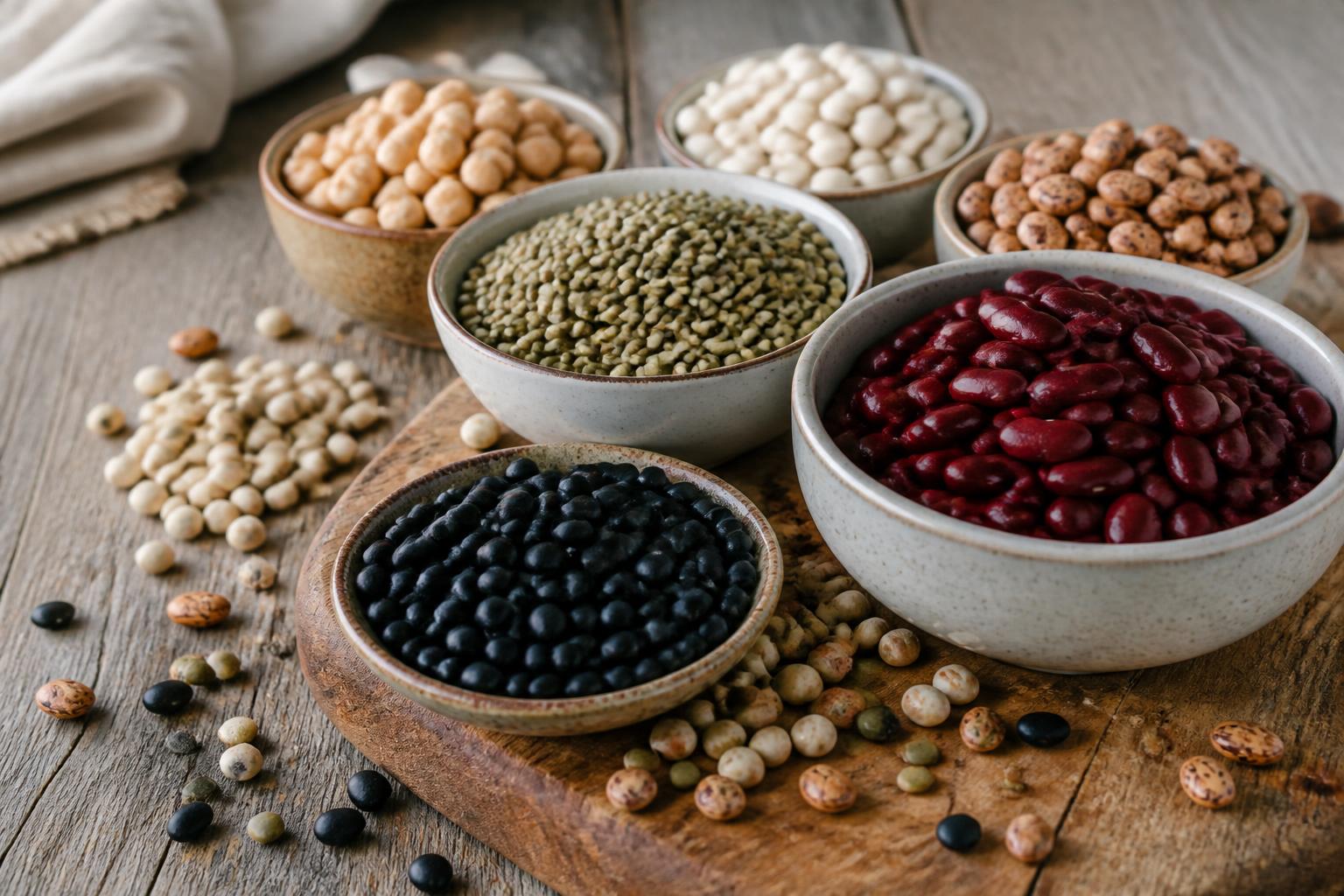
Protein claims also need context. Higher-protein meals can be useful for fullness, muscle maintenance, ageing, and some training goals. But "high protein" has become a cover line for books that merely add protein powder or large amounts of meat to ordinary recipes. A better sign is balanced use of eggs, dairy, fish, beans, lentils, tofu, chicken, grains and nuts, with portions that fit the rest of the meal. Readers interested in this area often benefit from understanding ordinary ingredients first, such as which beans give you the most protein.
Ultra-processed food claims are another area where books can overreach. The NOVA system is widely discussed, but it is not a complete shortcut to deciding whether a diet is healthy. Some ultra-processed foods are clearly worth limiting, such as many confectionery products and some heavily marketed snacks. Others, such as wholemeal sliced bread, fortified breakfast cereals, baked beans, or plant milks, may still have a useful place in a balanced diet depending on the product and the person. If a cookbook frames healthy eating as impossible unless you cook every sauce, stock and snack from scratch, it may be more ideological than practical.
Weight loss claims deserve particular caution. In the UK, books cannot make medical promises loosely, and readers should be wary of dramatic language around fat burning, detoxing, or resetting metabolism. Sustainable weight change usually comes from repeatable eating patterns, not a single miracle ingredient or rigid two-week plan. A sound cookbook may support weight management by making meals more filling, vegetable-rich, and easier to portion, but that is different from guaranteeing results.
Balanced eating is the broadest claim and often the safest, provided the book can show what balance means. Look for variety across the week, not perfection in every recipe. A cookbook does not need every dish to be low fat, low salt, high fibre and high protein all at once. It does need enough range that a normal reader could build balanced days from it.
Which cookbook style fits different UK households?
If you cook for one, avoid family-centred books unless they are very good on scaling down and leftovers. Single-cook households usually do best with books that either portion recipes clearly for one or two, or deliberately build "cook once, eat twice" systems. Soup, traybakes, lentil dishes, roasted vegetables, grain salads and freezer-friendly stews are especially useful here.
If you are feeding children, the key issue is not whether the book says "family friendly". It is whether the recipes are adaptable without requiring separate meals for adults and children. Good signs include mild base recipes with optional heat, sauces that can be served in or alongside, and ingredients children are likely to recognise alongside a gradual introduction to new flavours. Books that expect every meal to be highly spiced, heavily textured, or built around expensive fresh herbs can be harder to sustain in family use.
Batch cooks need structure. The best books for this household type tell you what freezes well, how long leftovers should keep in the fridge, and how to turn one base into several meals. A large pot of tomato and lentil sauce, for example, can become pasta, baked potatoes, soup, or a topping for roasted aubergine. Without that kind of guidance, batch cooking books can become a freezer full of food you do not actually want to eat later.
If your shopping options are limited, look for books that work with tinned, frozen and long-life ingredients. This matters in rural areas, for people without a car, and for anyone relying on smaller local shops between bigger shops. A strong practical title should not assume daily access to fresh fish, ripe avocados, or specialist greens. It should be able to build decent meals from frozen peas, chopped tomatoes, oats, eggs, potatoes, onions, carrots, beans and pasta.
Low-confidence cooks need books that teach quietly. Step-by-step photographs can help, but so can plain language, short methods, and recipes that explain what success looks like. Books written by experienced teachers often outperform glamorous chef titles here. If you are at the stage of improving habits rather than reinventing your whole diet, our piece on how to start eating healthy without overhauling everything follows the same practical approach.
Common trade-offs before you buy
Most healthy cookbooks involve compromises, and it is better to spot them before buying.
Speed versus cost is one of the most common. Very quick books often lean on pre-prepared ingredients, which can raise the cost per meal. Slower books built around dried pulses, whole vegetables and batch cooking may save money, but they ask more planning of you.
Simplicity versus variety is another trade-off. Books with short ingredient lists are easier to use on busy evenings, but they may repeat flavours or techniques. More ambitious titles can offer better variety and more interesting food, but they may demand more shopping, more washing up, and more confidence.
Nutrition detail versus ease of use can also pull in opposite directions. Some readers want full nutrition panels for every recipe, especially if they are tracking protein, energy, fibre, carbohydrate or salt. Others find this cluttered and would rather have broader guidance. In the UK, remember that recipe nutrition figures in books are estimates, not the same as regulated back-of-pack labels, and they may not reflect swaps or brand differences.
Specialist approaches versus long-term usability matter too. A book built around a particular eating pattern may be motivating in the short term, especially if it feels new and structured. But if it excludes too many ordinary foods, or depends on unusual ingredients, it may not earn repeated use. Long-term usefulness often comes from books that leave room for normal family meals, social eating, and changing appetites.
There is also the trade-off between inspiration and repetition. Some books are beautiful and genuinely widen your cooking. Others are workhorses. Ideally you want at least one of each, but if you are buying only one, the dependable weeknight book usually gives better value.
A simple checklist for comparing titles in a shop or online
First, read the contents page properly. Do the chapter headings reflect how you cook, such as quick dinners, lunches, traybakes, batch cooking, packed lunches, or budget meals? Or is the structure more aspirational than useful?
Second, inspect at least three sample recipes. One should be a weeknight dinner, one a lunch or breakfast, and one something slightly more involved. Check ingredient length, method clarity, likely washing up, and whether the timings seem believable.
Third, look for repeated specialist ingredients. One unusual item is fine. A pattern of them is a warning, especially if you are trying to keep costs down or shop locally.
Fourth, assess the nutrition language. Is the author explaining balanced meals, fibre, vegetables, protein and portions in a measured way, or leaning on dramatic claims? Be cautious if the book talks as though one ingredient category is ruining everyone's health.
Fifth, check whether advice matches trusted primary sources. For UK readers, that usually means comparing broad claims against the NHS, the Eatwell Guide, SACN reports where relevant, and specialist guidance from bodies such as the British Dietetic Association. Imported books can still be excellent, but some references may be based on US serving sizes, US fortification patterns, or non-UK labelling conventions.
Sixth, ask whether you would realistically cook five recipes from the book within the next month. Not admire them, cook them. If the answer is no, it is probably not the right first purchase.
Finally, think about where the book fits in your actual routine. The best healthy eating cookbooks are not necessarily the strictest, trendiest, or most photogenic. They are the ones that help you put decent meals on the table, again and again, with ingredients you can buy, methods you can follow, and advice that stands up once the cover copy is forgotten.

Questions about this article or a correction to suggest? Get in touch. Read more about our editorial approach.